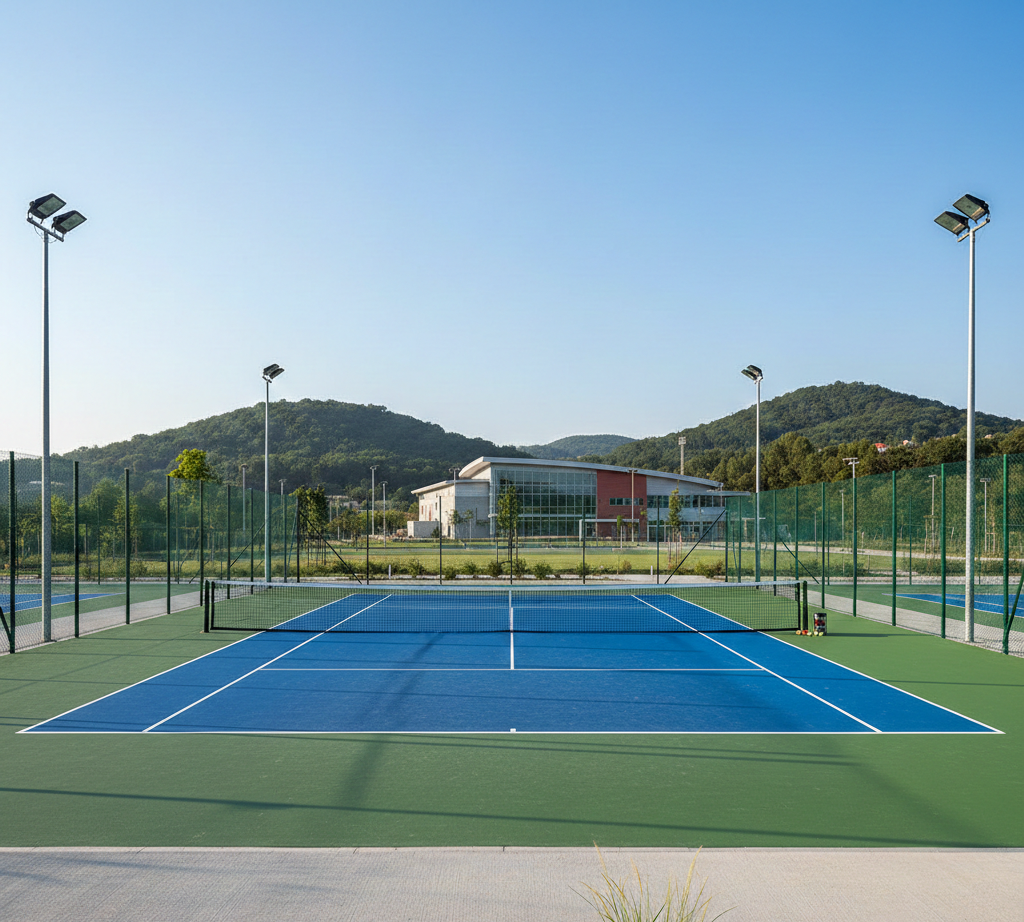
Introduction
This guide provides a comprehensive overview of synthetic tennis court construction, covering design specifications, materials, construction process, maintenance, and benefits.
2. Standard Dimensions of a Tennis Court
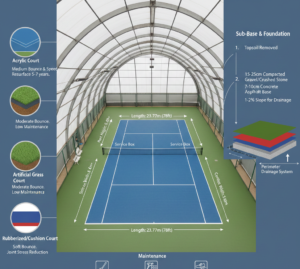
Even for synthetic courts, the dimensions follow International Tennis Federation (ITF) standards:
-
Length: 23.77 meters (78 feet)
-
Width: 8.23 meters (27 feet) for singles; 10.97 meters (36 feet) for doubles
-
Service Line: 6.40 meters from the net on each side
-
Net Height: 0.91 meters at the center; 1.07 meters at posts
-
Service Boxes: Divided by the center service line into two equal areas
-
Clearance/Run-Off Area: Minimum 6.40 meters behind baselines, 3.66 meters on sides
-
Indoor Ceiling Clearance: Minimum 9 meters for unobstructed play
3. Types of Synthetic Tennis Court Surfaces
Synthetic tennis courts come in several types based on material and intended use:
a) Acrylic Courts
-
Composition: Multi-layer acrylic coatings on concrete or asphalt base
-
Bounce: Medium and consistent
-
Speed: Medium
-
Maintenance: Periodic cleaning and resurfacing every 5–7 years
-
Best For: Professional training centers and multi-purpose indoor halls
b) Artificial Grass Courts
-
Composition: Synthetic grass fibers with shock-absorbing underlay
-
Bounce: Moderate, mimics natural grass
-
Maintenance: Minimal; occasional brushing and cleaning required
-
Best For: Residential complexes and outdoor recreational facilities
c) Rubberized or Cushion Courts
-
Composition: Rubberized layers with acrylic or polyurethane coating
-
Bounce: Soft and controlled, reducing joint stress
-
Maintenance: Low; easy to clean
-
Best For: Indoor sports halls and multi-sport facilities
Each surface type can be selected based on factors like budget, player preference, location, and climate.
4. Sub-Base and Foundation Requirements
A strong foundation is critical for the longevity and performance of a synthetic tennis court.
Steps for Sub-Base Preparation:
-
Excavation: Remove topsoil and level the site
-
Sub-Base Layer: Compact a 15–25 cm thick layer of gravel or crushed stone for drainage and stability
-
Base Layer: Apply concrete or asphalt layer, typically 7–10 cm thick for acrylic-based courts
-
Slope and Drainage: Introduce a 1–2% slope away from the center for water runoff
-
Perimeter Drainage System: Install drains around the court to prevent water accumulation and surface damage
For artificial grass or cushioned courts, proper leveling and shock-absorbing layers are crucial to prevent uneven bounce and ensure player safety.
6. Maintenance of Synthetic Tennis Courts
-
Acrylic Courts: Clean dirt and debris regularly; inspect cracks and resurface every 5–7 years
-
Artificial Grass: Brush fibers to maintain upright position; remove leaves, debris, and surface contamination
-
Rubberized Courts: Clean surface periodically; check for surface wear and reapply coatings as necessary
Proper maintenance preserves surface quality, ensures consistent bounce, and prevents injuries.
7. Safety Considerations
Safety is a key factor in synthetic tennis court design:
-
Ensure non-slip surface to prevent falls
-
Maintain adequate run-off areas: 6.40 meters behind baselines, 3.66 meters on sides
-
For indoor courts, provide ceiling clearance of 9 meters or more
-
Install perimeter fencing to protect players and spectators
-
Check net posts and equipment stability regularly
8. Advantages of Synthetic Tennis Courts
-
Durable and Weather-Resistant: Synthetic surfaces can withstand heavy usage and extreme weather
-
Consistent Bounce: Provides predictable ball behavior, enhancing player performance
-
Reduced Injuries: Shock-absorbing properties reduce strain on joints
-
Cost-Effective Over Time: Low maintenance and long lifespan make it economical
9. Choosing the Right Synthetic Court
| Factor | Acrylic Courts | Artificial Grass | Rubberized Courts |
|---|---|---|---|
| Usage Frequency | High | Medium | Medium-High |
| Maintenance Requirement | Moderate | Low | Low |
| Player Safety | High | High | Very High |
| Durability | Very High | High | High |
| Cost | Medium-High | Medium | Medium-High |
10. Conclusion
Synthetic tennis courts provide a modern, durable, and safe alternative to traditional clay, grass, or hard courts.
Investing in synthetic tennis court construction ensures long-lasting performance, low maintenance, and consistent playing conditions, making it an ideal choice for schools, sports academies, residential complexes, and outdoor recreational facilities. With careful planning and expert construction, a synthetic tennis court can serve as a hub for tennis training, competition, and community engagement for years to come.
FAQ – Synthetic Tennis Court Construction
1. What is synthetic tennis court construction?
Synthetic tennis court construction involves building a high-performance, artificial sports surface over a properly prepared concrete or asphalt base. Materials commonly used include:
-
Acrylic – Durable, UV-resistant, and ideal for outdoor courts
-
PU (Polyurethane) – Seamless, cushioned surface for professional play
-
PVC Vinyl – Indoor-friendly with shock absorption
These surfaces provide consistent bounce, safety, and long-term durability.
2. Why choose synthetic tennis courts?
Synthetic tennis courts are popular because they:
-
Offer uniform bounce and better gameplay
-
Reduce risk of injuries with anti-slip and shock-absorbing surfaces
-
Are low-maintenance compared to clay or natural grass courts
-
Are suitable for indoor and outdoor environments
-
Can be customized with colors, logos, and court markings
Ideal for sports academies, schools, clubs, residential complexes, and stadiums.
3. What types of synthetic tennis court surfaces are available?
Acrylic Tennis Court Surface
-
Best for outdoor courts
-
UV-resistant and weatherproof
-
Cost-effective
PU (Polyurethane) Tennis Court Surface
-
Premium seamless surface
-
Excellent cushioning and durability
-
Suitable for indoor and outdoor professional courts
PVC Vinyl Tennis Court Surface
-
Ideal for indoor courts
-
High shock absorption
-
Player-friendly for training academies
The choice depends on court location, usage frequency, and budget.
4. What is the cost of synthetic tennis court construction?
Approximate cost:
-
₹1,200 to ₹2,500 per sq. m. (depending on surface type, base, and thickness)
-
Full court construction may include base preparation, fencing, lighting, net posts, and customization
Costs vary based on location, contractor, and material selection.
5. How long does synthetic tennis court construction take?
Typical timeline:
-
Base preparation & curing: 15–20 days
-
Synthetic surface installation: 7–10 days
Weather conditions and site location may slightly affect installation duration.
6. What base is required for synthetic tennis courts?
A smooth, level, and well-cured RCC or asphalt base is essential. Key requirements:
-
Level and crack-free
-
Proper drainage for outdoor courts
-
Moisture-resistant
A quality base ensures long-term performance, durability, and adhesion.
7. Is synthetic tennis court safe for players?
Yes. Synthetic tennis courts provide:
-
Anti-slip surface
-
Shock absorption to reduce joint strain
-
Stable traction for fast lateral movements
-
Reduced risk of injuries
Ideal for schools, colleges, clubs, and professional training facilities.
8. What maintenance is required?
-
Daily sweeping or dry cleaning
-
Weekly damp mopping
-
Periodic inspection for cracks or surface wear
-
Recoating acrylic surfaces every 4–6 years
Proper maintenance ensures safety and longevity.
9. Can synthetic tennis courts be customized?
Yes. Courts can be customized with:
-
Color options (green, blue, red, etc.)
-
Standard line markings for singles and doubles play
-
School, academy, or club logos
-
Sponsor branding
Customization improves aesthetics, branding, and professional appeal.
10. Are synthetic tennis courts suitable for outdoor and indoor projects?
Absolutely. Acrylic surfaces are ideal for outdoor courts with UV and weather resistance. PU and PVC surfaces are preferred for indoor courts, providing comfort and professional-grade performance.
11. How long does a synthetic tennis court last?
-
Acrylic surfaces: 6–8 years
-
PU surfaces: 8–12 years
-
PVC indoor surfaces: 8–12 years
Longevity depends on installation quality, usage, and regular maintenance.